Rings in this post may or may not have identity. As always, the ring of  matrices with entries from a ring
  is denoted by
PI rings are arguably the most important generalization of commutative rings. This post is the first part of a series of posts about this fascinating class of rings.
Let  be a commutative ring with identity, and let
  be the ring of polynomials in noncommuting indeterminates
  and with coefficients in
  We will assume that each
  commutes with every element of If
  then is just the ordinary commutative polynomial ring
 ![C[x].](https://s0.wp.com/latex.php?latex=C%5Bx%5D.&bg=f9f9f9&fg=333333&s=0&c=20201002)
A monomial is an element of which is of the form  where
where  for all
  The degree of a monomial
  is defined to be
  For example,
  is a monomial of degree
  So an element of
  is a -linear combination of monomials, and we say that
  is monic if the coefficient of at least one of the monomials of the highest degree in is
  For example,
  is not monic because none of the monomials of the highest degree, i.e.
  and
and  have coefficient
  but
but  is monic.
Definition 1. A ring is called a polynomial identity ring, or PI ring for short, if there exists a positive integer  and a monic polynomial
  such that
  for all
  We then say that satisfies or is an identity of
Definition 2. Let be a commutative ring with identity, and let be a -algebra. If, in Definition 1, we replace  with
with  we will get the definition of a PI algebra. So is called a PI algebra if there exists a positive integer and a monic polynomial such that for all Note that since every ring is a -algebra, every PI ring is a PI algebra.
Example 1. Every commutative ring is a PI ring.
Proof. Since is commutative,  for all
  and therefore satisfies the monic polynomial
Remark 1. A PI ring could satisfy many polynomials. For example a finite field of order  satisfies the polynomial in Example 1, because it is commutative, and it also satisfies the polynomial
  Another example is Boolean rings; they satisfy the polynomial in Example 1, because they are commutative, and they also satisfy the polynomial
Example 2. If is a commutative ring with identity, then  is a PI ring.
Proof. Let  Then
Then  and so, by Cayley-Hamilton,

for some  Thus
Thus  commutes with every element of
  i.e.,
i.e.,

for all  Thus satisfies the monic polynomial

Example 3. The division ring of real quaternions  is a PI ring.
Proof. Recall that  where
where  Let
Let

It is easy to see that  Thus, since
  are in the center of
  we get that
  for all
  So
So  and hence, since
  is central,
  for all
  Therefore satisfies the monic polynomial
Remark 2. If is a PI ring with identity, then could satisfy a polynomial with a nonzero constant. For example, the ring  satisfies the polynomial in Example 1, and it also satisfies the polynomial
  Now suppose that has no identity, and has a nonzero constant
  So
So  where
where  has a zero constant. Now, what is
  Well, It is not defined because it is supposed to be
  but
but  does not exist. So if has no identity, all identities of must have zero constants.
Example 4. Any subring or homomorphic image of a PI ring is a PI ring.
Proof. If satisfies  then obviously any subring of satisfies too. If
  is a homomorphic image of then
  for some ideal
  of Now, it is clear that for any
  and any
  we have
  Hence if satisfies then
  satisfies too.
Example 5. If is a nilpotent ideal of a ring and is a PI ring, then is a PI ring.
Proof. So  for some positive integer Now suppose that satisfies a monic polynomial
  Then
Then

for all  and so
  Thus
Thus  and hence satisfies the monic polynomial
Example 6. A finite direct product of PI rings is a PI ring.
Proof. By induction, we only need to prove that for a direct product two PI rings. So let  be PI rings that, respectively, satisfy
  and let
  It is clear that for any polynomial
  and
and  we have

Therefore


because  and
and  So satisfies the monic polynomial
Exercise. Let be a ring with the center Suppose that for every  there exist
  such that
  Show that is a PI ring.
Hint. See the proof of Example 3.
Note. The reference for this post is Section 1, Chapter 13 of the book Noncommutative Noetherian Rings by McConnell and Robson. Example 3 was added by me.























 we denote by
  and
and  the center and the multiplicative group of
  be a division ring, and suppose that
  is a proper subdivision ring of
  i.e.
i.e.  is a subring of
  and
and  is clearly a proper subgroup of
  Now, one may ask: when exactly is
  The Cartan-Brauer-Hua theorem gives the answer:
  if and only if
  One side of the theorem is trivial: if
  then
then  be a division ring, and let
  such that
  Then
Then 
 the four elements
  and
and  are all nonzero hence invertible. Now,


 If
If  then
then  Let
Let  such that
 So every element of
  commutes with
  Now let
  Then
Then  because
  and therefore both
  commute with
  will also commute with
  and that’s a contradiction.
  is a field and
  the multiplicative group of
  and the special linear group
  in this blog several times. The general linear group
  and the special linear group
  defined by
  is an onto group homomorphism and
  In particular,
 the only group homomorphism
 defined by
  where
where  is the complex conjugate of
  is clearly a group homomorphism. In general, if
  is any group homomorphism, then
  is also a group homomorphism. In this post, we show that there are no other group homomorphisms
  But first, we need a useful little result from basic group theory.
 be groups, and let
  be group homomorphisms. If
  then there exists a group homomorphism
  such that
 defined by
  is a well-defined group homomorphism from
  to
to  Here is another way. Let
  and
and  Since
Since  defined by
  is a group isomorphism. Since
  the map
  defined by
  is a well-defined group homomorphism. Finally, we have the injective group homomorphism
  defined by
  Now, let
  Then
Then 

 is a group homomorphism if and only if
  where
where  and
and  is a group homomorphism. Conversely, suppose now that
  In this case,
  and so the only group homomorphism
  or
or  is the trivial one. Thus
  in this case are all trivial maps.
 Let
Let  Then, since the image of
  is an abelian group,
 Therefore the commutator subgroup of
  On the other hand, by
  So
So  and the result now follows from the Lemma.
  is a square matrix with entries from a field of characteristic zero such that the trace of
  is zero for all positive integers
  then
then  be a field, and let
  be the ring of
  For
For  let
let  denote the trace of
  If
If  The well-known fact we are now going to prove is that the converse is also true if the characteristic of
  such that
  for all integers
  Then
Then  an invertible matrix
  and a nilpotent matrix
  such that
 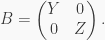 If
If  then
then  hence
hence  is nilpotent and we are done. We now suppose that
  and show that this case is impossible. For any positive integer
 be the characteristic polynomial of
  Note that since
  is invertible,
  By
By  where
where  identity matrix. Thus, taking the trace of both sides and using
  , gives
  which is not possible since
  and
and  To see that, look at the last sentence in the proof of the Theorem again. We got
  which implies
  and so
  which is not possible since
 For example, choose
  to be the identity matrix. Then
  we denote by
 ![[A,B]](https://s0.wp.com/latex.php?latex=%5BA%2CB%5D&bg=f9f9f9&fg=333333&s=0&c=20201002) the additive commutator of
the additive commutator of  i.e.
i.e. ![[A,B]=AB-BA.](https://s0.wp.com/latex.php?latex=%5BA%2CB%5D%3DAB-BA.&bg=f9f9f9&fg=333333&s=0&c=20201002) Clearly
Clearly ![[\ , \ ]](https://s0.wp.com/latex.php?latex=%5B%5C+%2C+%5C+%5D&bg=f9f9f9&fg=333333&s=0&c=20201002) is bilinear and
is bilinear and ![\text{tr}([A,B])=0.](https://s0.wp.com/latex.php?latex=%5Ctext%7Btr%7D%28%5BA%2CB%5D%29%3D0.&bg=f9f9f9&fg=333333&s=0&c=20201002)
 be such that
 ![[B_i,B_j]=A^{j-i}](https://s0.wp.com/latex.php?latex=%5BB_i%2CB_j%5D%3DA%5E%7Bj-i%7D&bg=f9f9f9&fg=333333&s=0&c=20201002) for all
for all  Prove that
![\text{tr}(A^k)=\text{tr}([B_1,B_{k+1}])=0,](https://s0.wp.com/latex.php?latex=%5Ctext%7Btr%7D%28A%5Ek%29%3D%5Ctext%7Btr%7D%28%5BB_1%2CB_%7Bk%2B1%7D%5D%29%3D0%2C&bg=f9f9f9&fg=333333&s=0&c=20201002)

 we are done. Suppose now that
  Since
Since  the set
  is
is  and
and  such that
  But then
![\displaystyle \begin{aligned}A^{m-1}=[B_p,B_{m+p-1}]=[\sum_{i=1}^{p-1}c_iB_i,B_{m+p-1}]=\sum_{i=1}^{p-1}c_i[B_i,B_{m+p-1}]=\sum_{i=1}^{p-1}c_iA^{m+p-1-i}=0,\end{aligned}](https://s0.wp.com/latex.php?latex=%5Cdisplaystyle+%5Cbegin%7Baligned%7DA%5E%7Bm-1%7D%3D%5BB_p%2CB_%7Bm%2Bp-1%7D%5D%3D%5B%5Csum_%7Bi%3D1%7D%5E%7Bp-1%7Dc_iB_i%2CB_%7Bm%2Bp-1%7D%5D%3D%5Csum_%7Bi%3D1%7D%5E%7Bp-1%7Dc_i%5BB_i%2CB_%7Bm%2Bp-1%7D%5D%3D%5Csum_%7Bi%3D1%7D%5E%7Bp-1%7Dc_iA%5E%7Bm%2Bp-1-i%7D%3D0%2C%5Cend%7Baligned%7D&bg=f9f9f9&fg=333333&s=0&c=20201002)
 for all
  But
But  contradicts the minimality of
 and if
  are nonzero derivations of
  can never be a derivation of
  Let
Let  an integer. Recall that we say that
  implies
  We say that
  if
if  for all
  It is clear that if
  The simple point I’d like to make here is that the converse is not always true. That will make a lot more sense if you look at its contrapositive, in fact the contrapositive of a stronger statement:
  does not always imply that
  However, the converse is true if
  and
and  Then
Then  and
and  So
So 
 Then
Then  i.e.
i.e.  for all
 and so, since





 that
that 
 in
in  gives
gives 


 -torsion free
  be a derivation of
  is a derivation of
 and
and  in Lemma 1 gives
  for all
  So, since
  for all
  and hence
  because
  for all
  and some
  or
or  we have
  for all
  and so
 for all
  and hence, since
  for all
 The proof is similar, just this time replace
 and let
  be derivations of
  or
or 
 is the same as saying that
  gives
gives
 and so the above becomes
 or
or  If
If  we are done. So suppose that
  which holds by Lemma 1, gives
  Hence
Hence  and so
  Thus, since
![R:=\mathbb{Z}_2[x],](https://s0.wp.com/latex.php?latex=R%3A%3D%5Cmathbb%7BZ%7D_2%5Bx%5D%2C&bg=f9f9f9&fg=333333&s=0&c=20201002) and the derivation
and the derivation  Then
Then  but
but  is a derivation.
 for all integers
  -algebra and
  where
where  are integers and
  then
then  and so
  Thus every derivation of a
![\mathbb{C}[x].](https://s0.wp.com/latex.php?latex=%5Cmathbb%7BC%7D%5Bx%5D.&bg=f9f9f9&fg=333333&s=0&c=20201002) Then the derivation
Then the derivation  is locally nilpotent because if
  has degree
 The polynomial ring in the above Example gives one of those algebras since, in that example,
  It turns out that any such algebra is a polynomial ring!
 If there exists
  such that
  then
then  is transcendental over
  and
and ![R=K[x].](https://s0.wp.com/latex.php?latex=R%3DK%5Bx%5D.&bg=f9f9f9&fg=333333&s=0&c=20201002)
 and let
  for some
  Then, since by the product rule,
  we have

 So
So  We now show that
  be the smallest positive integer
  The proof is by induction over
  If
If  then
then  and so
 ![a \in K \subset K[x].](https://s0.wp.com/latex.php?latex=a+%5Cin+K+%5Csubset+K%5Bx%5D.&bg=f9f9f9&fg=333333&s=0&c=20201002) Suppose now that
Suppose now that  Let
Let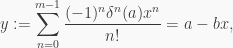
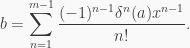
 and so we are done if we prove that
 ![b,y \in K[x].](https://s0.wp.com/latex.php?latex=b%2Cy+%5Cin+K%5Bx%5D.&bg=f9f9f9&fg=333333&s=0&c=20201002)




![b \in K[x].](https://s0.wp.com/latex.php?latex=b+%5Cin+K%5Bx%5D.&bg=f9f9f9&fg=333333&s=0&c=20201002)

 for all
  because if
  then
then  and if
  then
then  Thus
Thus  and so
  Hence, by our induction hypothesis,
 ![b \in K[x]. \ \Box](https://s0.wp.com/latex.php?latex=b+%5Cin+K%5Bx%5D.+%5C+%5CBox&bg=f9f9f9&fg=333333&s=0&c=20201002)
 Let
Let  and define the map
  by
by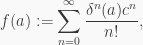
 the center of
  then
then 

 is additive and satisfies the product rule. So let
  Then
Then 





![\mathbb{C}[x]](https://s0.wp.com/latex.php?latex=%5Cmathbb%7BC%7D%5Bx%5D&bg=f9f9f9&fg=333333&s=0&c=20201002) and consider the derivation
and consider the derivation  is not a derivation because if it was, then we would have
  but we know that
 be the ring of
  Define the map
  as follows: for any
 ![A=[a_{ij}] \in M_n(R),](https://s0.wp.com/latex.php?latex=A%3D%5Ba_%7Bij%7D%5D+%5Cin+M_n%28R%29%2C&bg=f9f9f9&fg=333333&s=0&c=20201002) where
where  is the
  -entry of
 ![\Delta(A)=[\delta(a_{ij})].](https://s0.wp.com/latex.php?latex=%5CDelta%28A%29%3D%5B%5Cdelta%28a_%7Bij%7D%29%5D.&bg=f9f9f9&fg=333333&s=0&c=20201002) Then
Then 
 is clearly additive too. So we only need to show that
 ![A=[a_{ij}], \ B=[b_{ij}] \in M_n(R).](https://s0.wp.com/latex.php?latex=A%3D%5Ba_%7Bij%7D%5D%2C+%5C+B%3D%5Bb_%7Bij%7D%5D+%5Cin+M_n%28R%29.&bg=f9f9f9&fg=333333&s=0&c=20201002) Let
Let  be, respectively, the
  and the
  Then
Then  and so
 So
So  hence the result.
  and
and 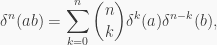
 Here
Here  is defined to be the identity map.
  Now, assuming that the formula holds for




![\displaystyle =\sum_{k=1}^{n+1}\left[\binom{n}{k-1}+\binom{n}{k}\right]\delta^k(a)\delta^{n-k+1}(b)+a\delta^{n+1}(b)](https://s0.wp.com/latex.php?latex=%5Cdisplaystyle+%3D%5Csum_%7Bk%3D1%7D%5E%7Bn%2B1%7D%5Cleft%5B%5Cbinom%7Bn%7D%7Bk-1%7D%2B%5Cbinom%7Bn%7D%7Bk%7D%5Cright%5D%5Cdelta%5Ek%28a%29%5Cdelta%5E%7Bn-k%2B1%7D%28b%29%2Ba%5Cdelta%5E%7Bn%2B1%7D%28b%29&bg=f9f9f9&fg=333333&s=0&c=20201002)


 is a subring of
  let
let
 Then
Then  is a subring of
  for all
 is an abelian group for all
  So
So  is an abelian group, and so we only need to show that
  for all
  and
and  We want to show that
  So
So  We also have, by Leibniz formula,
 then
then  and if
  then
then  and therefore
  Thus
Thus  and so
 denotes the center of a ring
 ![\mathbb{C}[x],](https://s0.wp.com/latex.php?latex=%5Cmathbb%7BC%7D%5Bx%5D%2C&bg=f9f9f9&fg=333333&s=0&c=20201002) we have the familiar concept of differentiation with respect to
we have the familiar concept of differentiation with respect to  i.e.
i.e.  This is a map form
 ![\mathbb{C}[x] \to \mathbb{C}[x]](https://s0.wp.com/latex.php?latex=%5Cmathbb%7BC%7D%5Bx%5D+%5Cto+%5Cmathbb%7BC%7D%5Bx%5D&bg=f9f9f9&fg=333333&s=0&c=20201002) which is additive and satisfies the product rule. Also,
which is additive and satisfies the product rule. Also,  We now extend this concept to rings in general.
 that satisfies the product rule:
  for all
  the set of all derivations of
 ![R[x].](https://s0.wp.com/latex.php?latex=R%5Bx%5D.&bg=f9f9f9&fg=333333&s=0&c=20201002)
![R[x]](https://s0.wp.com/latex.php?latex=R%5Bx%5D&bg=f9f9f9&fg=333333&s=0&c=20201002) be the ring of polynomials over
be the ring of polynomials over ![\delta : R[x] \to R[x]](https://s0.wp.com/latex.php?latex=%5Cdelta+%3A+R%5Bx%5D+%5Cto+R%5Bx%5D&bg=f9f9f9&fg=333333&s=0&c=20201002) by
by
![\delta \in \text{Der}(R[x]).](https://s0.wp.com/latex.php?latex=%5Cdelta+%5Cin+%5Ctext%7BDer%7D%28R%5Bx%5D%29.&bg=f9f9f9&fg=333333&s=0&c=20201002) The derivation
The derivation  Note that, for the definition to make sense, the term
  for
for  is defined to be
  and
and  is defined to be
 ![p(x), q(x) \in R[x].](https://s0.wp.com/latex.php?latex=p%28x%29%2C+q%28x%29+%5Cin+R%5Bx%5D.&bg=f9f9f9&fg=333333&s=0&c=20201002) So we can write
So we can write  Then
Then 






 for all
  and it’s called an inner derivation.




 is invertible in
  so if
so if  for all

 then
then  for all integers
  where, for

 and so
  hence
hence  Also, by product rule,
  and so
  hence
hence 
 then since
  and so
  Also, by product rule,
  and so
 and so
 for some
  and all
  gives
gives  and so
  Conversely, if
  then, by product rule,
 Then
Then
 proving that
 is stronger than
  Now, the proof is by induction over
  Assuming the identity holds for
 the ring of
  matrices with complex entries. Let
  Now, choose
  Then
Then  is the identity matrix and so
  Also,
Also, 
 and
and  then, by Remark iv),
  for all
  i.e.
i.e. 
 day!
day! be the ring of
  and
and  then
then 
 where
where  Let
Let  Then
Then 

 and
and 



 then
then  and so
  If
If  then
then  is not a real number. But both
  and
and  are real numbers, and hence, by
  we must have
  So either way,
 Abstract Algebra